

Key Takeaways
- A complete Orlando aftercare plan contains four parts: written discharge planning, named continuing care, naloxone with overdose education, and a scheduled follow-up call from the detox team 6.
- Opioid tolerance can disappear in about a week, making the first 14 days home the highest-risk window and the reason naloxone and uninterrupted MOUD belong in the house immediately 3, 2.
- Pressure-test any Orange County plan against real geography: addresses, days, times, and transportation across I-4, Lake Nona, downtown, and I-Drive decide whether appointments actually happen.
- Compare recommended levels of care in writing, request a care conference two or three days before discharge, and insist on a clinician-to-clinician warm handoff rather than a referral slip 1.
The week your partner comes home from detox
The discharge paperwork is sitting on your kitchen counter. Your partner is upstairs, finally sleeping in your bed instead of a clinical one. And you are standing there wondering what, exactly, you are supposed to do next.
If you are reading this somewhere in Orlando, maybe at a table in Baldwin Park or in a quiet corner of a Lake Nona apartment, you already know the hardest part of detox is not detox. It is the week that follows. The structure drops away. The nurses and counselors are gone. The appointments that felt automatic inside the facility now depend on you, your partner, a car, a phone, and a calendar that suddenly has to hold everything together.
That first week is a lot. Give yourself permission to say so.
Federal guidance is clear that leaving medically supervised care should not feel like being handed a stack of brochures and shown the door. SAMHSA describes a true transition as an individualized plan with mutually agreed referrals and a warm handoff into continuing medical, behavioral, or community services 1. That standard exists because the days just after detox carry real clinical risk, especially around reduced tolerance and interrupted medication 2.
You are not a bystander in this. You are the person who notices what the discharge team cannot see from inside the facility. The goal of this guide is to help you co-plan the next step across Orange County, protect your partner during the fragile first weeks, and know when to call for backup. One honest conversation and one scheduled appointment is a real win. Start there.
What a real aftercare plan actually contains
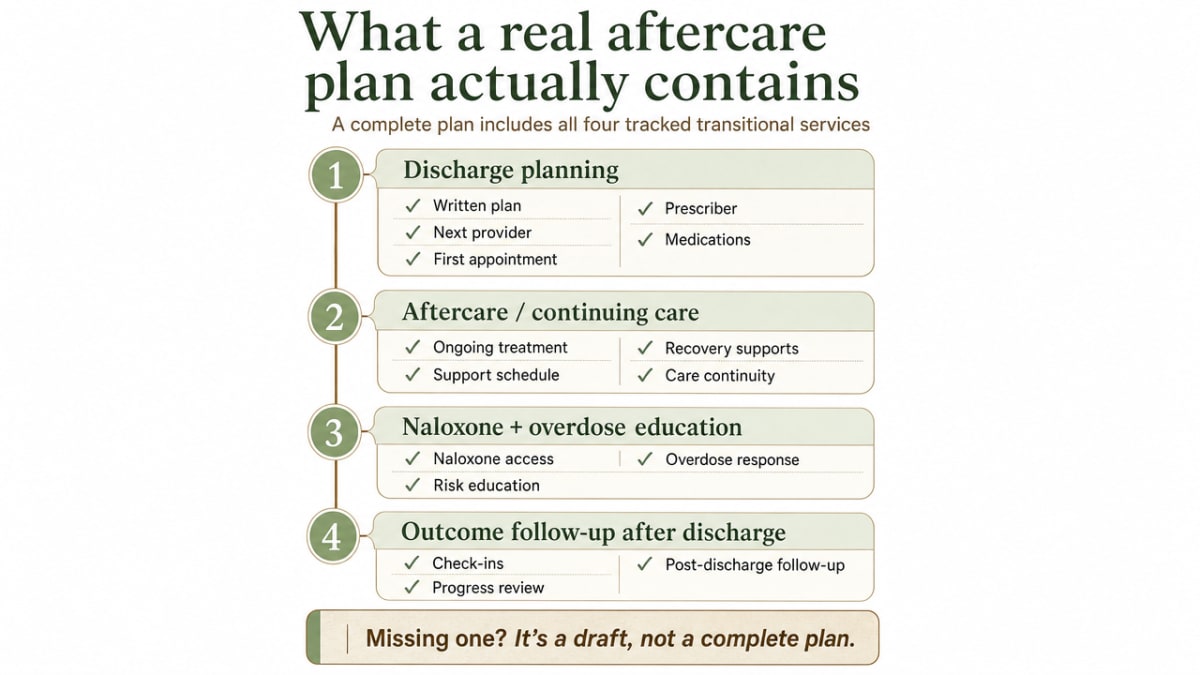
Before you can judge whether the plan in your hand is any good, you need a yardstick. The federal government actually tracks what counts as a complete transition out of substance-use treatment, and that framework is the cleanest tool you have for pressure-testing whatever paperwork your partner’s discharge coordinator hands you.
SAMHSA’s national facility survey measures four distinct transitional services separately: discharge planning, aftercare or continuing care, naloxone and overdose education, and outcome follow-up after discharge 6. If your partner’s plan is missing one of those four, it is not a complete plan. It is a draft.
Here is what each one should actually look like when you read it:
- Discharge planning
- is the written document itself. It should name the next provider, the first appointment date, a prescriber for any medications, and who to call after hours. SAMHSA’s opioid-treatment guidance calls this an individualized transition plan with mutually agreed referrals and a warm handoff, meaning the detox team talks directly to the next provider rather than printing a phone number for you to dial on your own 1. If the plan reads like a generic list of Orlando clinics, push back and ask who is making the call.
- Continuing care
- is the actual treatment that follows detox: outpatient therapy, an intensive outpatient program, medication management, peer support, or a residential step-down. For patients with co-occurring conditions, federal guidance recommends the initial plan spell out level of care, continuing-care recommendations, discharge criteria, and recovery supports in one place 5. One line that says “recommend outpatient” is not continuing care. A named program with an intake date is.
- Naloxone and overdose education
- is non-negotiable if opioids were part of the picture, and arguably useful even if they were not, since mixed-substance use is common. You should leave with naloxone in hand or a prescription you can fill that day, plus a short conversation about how to use it. More on why in the next section.
- Outcome follow-up
- means someone from the discharge team checks in after your partner is home, usually by phone, to confirm the first appointment happened and medications were filled. Ask directly: who calls, when, and what happens if we miss them?
When you sit down for the discharge meeting, bring those four categories as a checklist. If the coordinator can walk you through each one with names, dates, and phone numbers, you have a real plan. If three of the four are vague, you have homework before your partner walks out the door, and that is a reasonable thing to say out loud.
The first 14 days home: the tolerance window nobody warned you about
Here is the part most discharge conversations rush through, and the part you need to understand cold before your partner walks through the front door.
When someone uses opioids regularly, their body builds tolerance to the dose. Detox strips that tolerance away fast. Federal clinical guidance states that it can take as little as a week of abstinence to lose opioid tolerance, which means a dose that felt routine two weeks ago can now be fatal 3. The CDC guideline makes the same point in blunter clinical terms: patients leaving periods of abstinence have reduced tolerance and face elevated overdose risk, which is why overdose education and naloxone are standard parts of the conversation at discharge 2.
Here is what that plan should actually look like in your house.
Days 1 to 3. Naloxone is in the home, not in a pharmacy queue. Two doses, somewhere obvious, and you know how to use them. If opioids were part of your partner’s story, the CDC guideline treats this as baseline, not optional 2. Any medication for opioid use disorder, usually buprenorphine or methadone, should already be filled or scheduled for dosing. A gap of even a few days here is the exact scenario federal guidance warns against 3. If your partner left detox on a Friday and the first MOUD appointment is the following Thursday, that is a planning failure worth calling the discharge coordinator about on Monday morning.
Days 4 to 7. The first outpatient or intensive outpatient appointment happens. Not scheduled, happens. You put it on both of your phones. If transportation is thin, the Lake Nona or downtown Orlando appointment that looked fine on paper can quietly collapse into a missed intake. Call the day before and confirm. A kept first appointment is a real win and worth naming out loud.
Days 8 to 14. Sleep is still bad. Mood is swinging. Cravings often spike in the second week, not the first, which surprises almost everyone. This is also when the discharge team’s follow-up call should land. If no one has checked in by day 10, call them. Keep naloxone where it has been. Do not move it to a drawer because things seem calmer.
One more thing worth saying plainly. If your partner used alcohol or benzodiazepines rather than opioids, the overdose math is different, but the fragility is not. Returning to a prior drinking pattern after detox carries its own medical risks, and the SAMHSA transition framework still expects a warm handoff into continuing care rather than a printed list of numbers 1.
You are not being paranoid by keeping naloxone on the counter and a follow-up appointment on the fridge. You are doing the exact work the federal guidance asks the care team to do with you. That counts.
Choosing the right level of care after detox
Detox treats the body. What comes next treats the pattern. The question in front of you is not whether your partner needs continuing care, it is which intensity makes sense for the next 30 to 90 days, and that answer should be written down by the clinical team, not guessed at your kitchen table.
Federal guidance frames this as a continuum, not a menu. The CMCS and SAMHSA joint bulletin states that the initial service plan should spell out treatment, level of care, continuing-care and recovery-support recommendations, and discharge criteria in one document 5. In plain language, your partner’s plan should name the setting, say why that setting was chosen over a more or less intensive one, and describe what has to happen before stepping down.
Three levels tend to come up in post-detox planning in Orlando.
- Residential or inpatient rehab keeps your partner in a 24-hour clinical setting for roughly two to four weeks. It is the right call when the home environment has active triggers, when co-occurring conditions like untreated bipolar disorder or severe PTSD are in play, or when a prior outpatient attempt did not hold.
- Partial hospitalization or intensive outpatient runs five to six hours a day, three to five days a week, with your partner sleeping at home. It fits when the home is stable, transportation to a downtown Orlando or Lake Nona program is reliable, and the clinical team believes structured daytime support is enough.
- Standard outpatient and medication management is a weekly therapy appointment plus a prescriber visit, often with peer support layered in. For opioid use disorder, the CDC guideline is explicit that detoxification alone, without medication for opioid use disorder, is not recommended as a standalone approach 2. If opioids were part of the story and no one has mentioned buprenorphine, methadone, or naltrexone, that is the first question to ask.
Here is the honest part. The level of care your insurance will authorize and the level your partner clinically needs are not always the same conversation. Ask the discharge coordinator to document the clinical recommendation first, then work the authorization problem. If a step-down from residential to intensive outpatient is denied, that written recommendation is what you appeal with.
One scheduled intake, at the right level, is a real win. Name it as one.
Mapping aftercare across Orange County
Orlando is not one city for aftercare purposes. It is a loose constellation of medical districts, residential neighborhoods, and corridors that each hold different pieces of the continuing-care puzzle. The partial hospitalization program in Lake Nona is a 25-minute drive from a house in Winter Park on a good day, 50 minutes on a bad one. The MOUD prescriber downtown may have Thursday openings while the counselor in east Orlando only has Tuesdays. The intake coordinator at an International Drive outpatient program may need you to show up in person before they will schedule a first visit. These are the frictions that quietly undo good plans.
Start with a simple exercise at the kitchen table before discharge. Write down four things for every appointment on the proposed plan: the address, the day of the week, the time, and how your partner gets there. If three of five appointments require a 40-minute drive across I-4 at rush hour, the plan is not realistic no matter how clinically sound it looks on paper. LYNX routes cover most of downtown and the I-Drive corridor reasonably well. They thin out fast in parts of east Orange County and around Lake Nona. If your partner cannot drive, or should not be driving yet, that constraint belongs in the plan, not in a surprise text at 7 a.m.
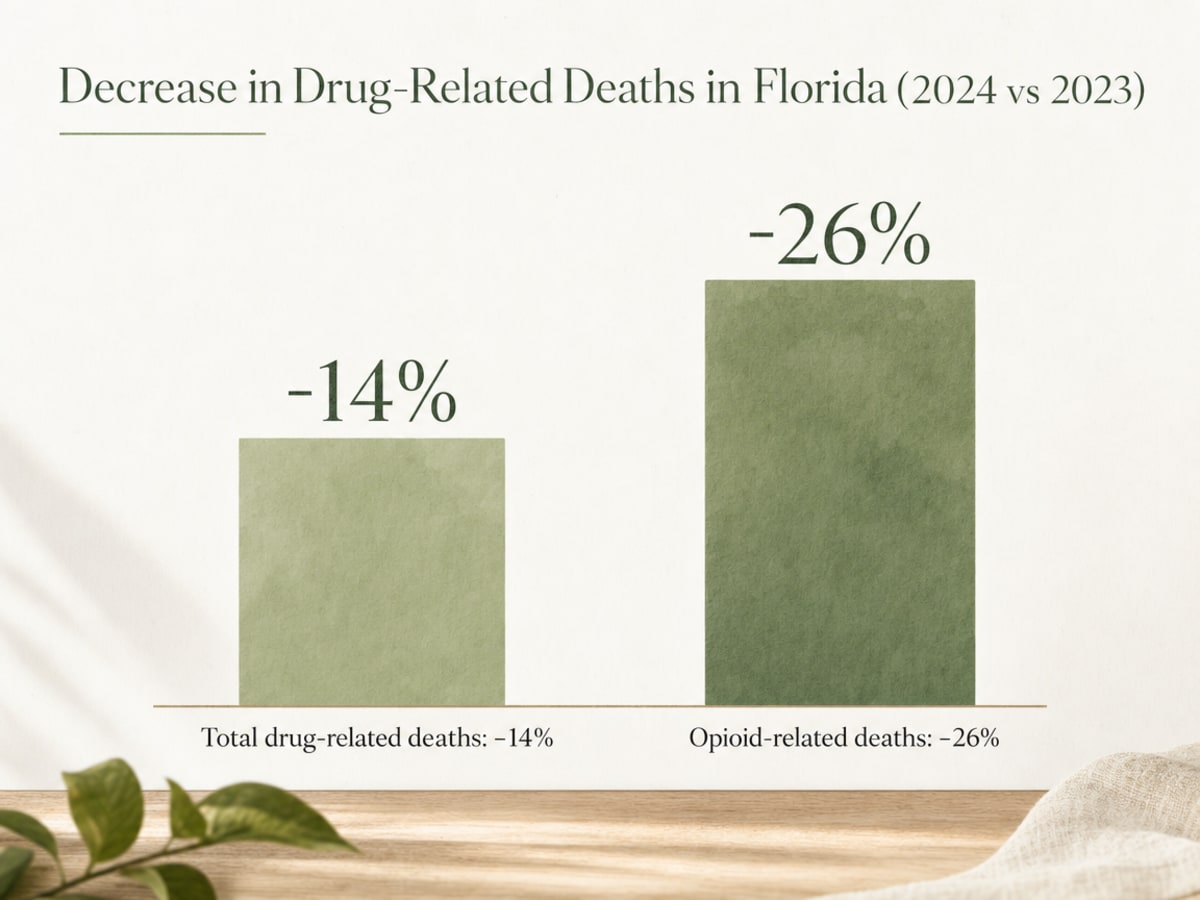
The local urgency is real, and it is also moving in the right direction. The Florida Department of Health reports that total drug-related deaths decreased 14% and opioid-related deaths decreased 26% in 2024 compared with 2023 8. Those are statewide figures, not Orange County figures, and declines do not land evenly across counties, substances, or demographics. The point is not that the risk is gone. It is that coordinated care, naloxone access, and medication for opioid use disorder are doing measurable work when they reach people. Your partner is one of the people they need to reach. For a county-level view you can check yourself, Florida Health CHARTS publishes an Orange County substance-use dashboard that is worth bookmarking during the first few months home 9.
A few practical mapping notes that save real time. If your partner’s prescriber is downtown and the therapist is in Lake Nona, see if the therapist offers telehealth for at least every other session. If an intensive outpatient program near I-Drive runs mornings, protect the morning calendar aggressively and schedule nothing else before noon on program days. If a peer-support meeting on the east side runs Tuesday nights, build dinner around it rather than treating it as something to fit in afterward.
One kept appointment this week beats three ambitious ones that fall apart on the Beachline. Build the plan for the Orlando you actually drive, not the Orlando that looks tidy on a map.
Talking with your partner without pushing them away
You already know the tone matters. One wrong sentence at the wrong hour can end a conversation you have been trying to have for a month. And you are tired, which is the exact condition under which wrong sentences happen.
SAMHSA’s family guide is useful here because it does not ask you to be perfect. It asks you to create a judgment-free environment, stay patient while services get lined up, and lean on outside help like the national treatment-referral helpline when you need a sounding board that is not your partner 4. Judgment-free does not mean agreement with everything. It means your partner can tell you cravings came back on the drive home from the Lake Nona appointment without bracing for a lecture.
A few lines that tend to work better than the ones most of us reach for first:
- Instead of “Did you take your medication?” try “How did this morning go?” The first is a check. The second is a door.
- Instead of “You can’t miss this appointment,” try “What would make Thursday easier?” Transportation, timing, or just dread of walking in the door are all fixable once named.
- Instead of “I’m scared you’ll relapse,” try “I want to keep the naloxone where we agreed. Is that still okay with you?” Specific, shared, not accusatory.
Protect your own bandwidth too. You are not the therapist, the sponsor, or the prescriber, and you cannot be. If the conversation stalls, the 988 Suicide and Crisis Lifeline and SAMHSA’s confidential helpline exist for both of you, not just for your partner in a crisis moment 4. Calling once to ask a question is a reasonable thing to do on a Tuesday night.
One honest sentence that lands softly is a real win. You do not need to fix the week in a single conversation. You just need to keep the next one possible.
Coordinating the handoff before discharge day
The best aftercare plans get built two or three days before discharge, not two hours before. If your partner’s expected release is Friday, Wednesday is when you want to be sitting down with the discharge coordinator, not standing in the lobby signing papers while someone hands you a folder.
Ask for a care conference. Most detox facilities will schedule one if you request it, and your partner can sign a release of information so you are allowed in the room. That release is the hinge. Without it, HIPAA keeps the clinical team from telling you anything specific, which turns you into a chauffeur instead of a co-planner. With it, you can hear the medication plan, the follow-up schedule, and the clinical reasoning behind the recommended level of care in one conversation.
Bring a short list to that meeting. Who is the next prescriber, and is the first appointment on the calendar before discharge? Has the detox team spoken directly with that provider, or just handed over a phone number? SAMHSA’s standard is a mutually agreed plan and a warm handoff, meaning clinician-to-clinician contact rather than a referral slip in your pocket 1. If the answer is “we gave them the number,” ask whether someone can call before your partner leaves the building.
Confirm three concrete things before you drive away on discharge day:
- The medication is prescribed and either in hand or at a pharmacy you can reach that afternoon.
- The first continuing-care appointment is on both of your calendars with the address and a contact number.
- Naloxone, if opioids were involved, is physically with you, not on a to-do list 2.
Florida lawmakers have filed proposals that would formalize this kind of documented handoff for behavioral-health facilities, which signals where the standard is heading even before any bill becomes law 10.
A care conference held, a release signed, a prescriber on the phone with the detox nurse. Three small wins stacked together, and discharge day stops feeling like a cliff.
When relapse happens: the plan you hope not to use
You need this plan written down before you need it. Not because you expect to use it, but because the night you might use it is not the night to be figuring it out.
A slip is not a failure of your partner’s character or of your week of hard work. It is a clinical event, and it has a response. Three things belong in a one-page document on the fridge or in a shared note on your phones.
- Overdose first. If your partner is unresponsive, breathing is slow or stopped, or lips are turning blue, give naloxone and call 911. Give a second dose if there is no response in two to three minutes. Opioid tolerance drops fast after detox, which is why federal guidance treats naloxone as standard household equipment during this window 2, 3. You do not need to know for certain what they used. Naloxone will not hurt them if opioids were not involved.
- Then the clinical call. The prescriber or outpatient program gets a call the next morning, not next week. A slip usually means the level of care needs to step up, not that treatment failed. That is a conversation the clinical team is trained to have 1.
- Then you. Call SAMHSA’s confidential helpline or 988 for yourself if you need to talk it through before you talk to your partner 4. One steady response, not a perfect one, is the win here.
Frequently Asked Questions
When should aftercare planning start for my partner in detox?
Aftercare planning should start the moment your partner is medically stable, not on discharge day. Ask the facility to schedule a care conference two or three days before release so you can hear the medication plan, continuing-care referral, and follow-up schedule in one conversation. SAMHSA frames the goal as an individualized transition plan with mutually agreed referrals and a warm handoff to the next provider, not a folder of phone numbers 1.
What should a complete aftercare plan include?
Four pieces: a written discharge plan with named providers and dates, a continuing-care referral at the right level of intensity, naloxone and overdose education when opioids are involved, and a scheduled follow-up call from the discharge team after your partner is home. SAMHSA tracks these as separate transitional services across treatment facilities, so if any one is vague or missing, the plan is incomplete and worth pushing back on before discharge 6.
Why is the first week home after detox so high-risk for overdose?
Tolerance drops fast during abstinence. Federal clinical guidance states it can take as little as a week to lose opioid tolerance, which means a dose your partner used before detox can now be fatal 3. The week they feel most physically recovered is often the week relapse risk peaks. Keeping naloxone in the home, continuing medication for opioid use disorder without gaps, and attending the first outpatient appointment are the protective steps that matter most.
How involved can I be in my partner’s aftercare without violating their privacy?
As involved as your partner consents to. Ask them to sign a release of information naming you before discharge. That release lets clinicians share the medication plan, appointment schedule, and clinical reasoning with you directly. Without it, HIPAA limits what the team can tell you. SAMHSA’s family guide encourages a judgment-free environment and patient, consented involvement rather than taking over decisions, and points to the confidential helpline when you need outside support 4.
How do I choose between outpatient, intensive outpatient, or residential care after detox in Orlando?
Let the clinical team recommend the level in writing, then stress-test it against your home and your Orange County commute. Residential fits active triggers at home or untreated co-occurring conditions. Intensive outpatient fits a stable home with reliable transportation to downtown or Lake Nona. Standard outpatient fits lower-acuity cases, usually with medication management. Federal guidance expects the plan to document level of care, continuing-care recommendations, and discharge criteria together, not as separate guesses 5.
What should I do if my partner relapses during the first weeks home?
Treat it as a clinical event, not a verdict. If opioids may be involved and your partner is unresponsive or breathing slowly, give naloxone and call 911; give a second dose in two to three minutes if needed 2. The next morning, call the prescriber or outpatient program to discuss stepping up the level of care rather than starting over 1. Then call SAMHSA’s helpline or 988 for yourself if you need to talk it through 4.
References
- Federal Guidelines for Opioid Treatment Programs. https://library.samhsa.gov/sites/default/files/federal-guidelines-opioid-treatment-pep24-02-011.pdf
- CDC Clinical Practice Guideline for Prescribing Opioids for Pain — United States, 2022. https://www.cdc.gov/mmwr/volumes/71/rr/rr7103a1.htm
- HHS Guide for Clinicians on the Appropriate Dosage Reduction or Discontinuation of Long-Term Opioid Analgesics. https://www.cdc.gov/overdose-prevention/media/pdfs/2024/03/Guide-for-Clinicians-on-the-Appropriate-Dosage-Reduction-Opioid-Analgesics.pdf
- Helping a Loved One Dealing with Mental and/or Substance Use Problems. https://www.samhsa.gov/sites/default/files/samhsa_families_family_support_guide_final508.pdf
- Joint CMCS and SAMHSA Informational Bulletin. https://www.medicaid.gov/federal-policy-guidance/downloads/CIB-01-26-2015.pdf
- Take Part in the 2024 National Substance Use and Mental Health Services Survey. https://www.samhsa.gov/data/sites/default/files/reports/rpt45293/n-sumhss-2024-questionnaire.pdf
- Treatment Episode Data Set (TEDS) 2024. https://www.samhsa.gov/data/sites/default/files/reports/rpt57179/2024-teds-annual-report.pdf
- Drug Overdose Surveillance & Epidemiology. https://www.flhealth.gov/statistics-data/overdose-reporting/
- Substance Use Dashboard: Report. https://www.flhealthcharts.gov/ChartsDashboards/rdPage.aspx?rdReport=SubstanceUse.Report&islCounty=6
- Florida Senate Bill 1439 — Filed Bill Text. https://www.flsenate.gov/Session/Bill/2025/1439/BillText/Filed/PDF